 Charlie Glover, T.L.L. Temple Foundation
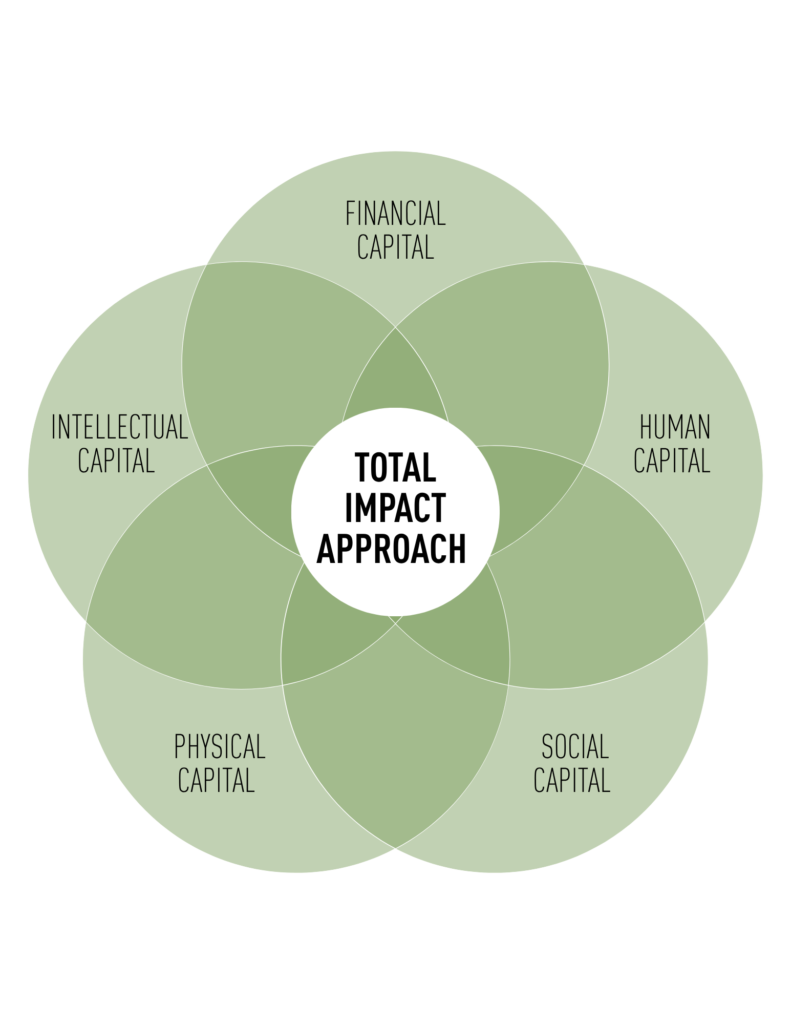
A private foundation can create impact through more than grantmaking alone. While charitable giving remains a core tool, it is only one form of capital available to advance mission. Foundations also bring human capital through the expertise and leadership of their staff and board, social capital through the relationships and trust they hold across sectors and communities, physical capital through the assets, spaces, land, infrastructure, and tangible resources they maintain, and intellectual capital through the ideas, frameworks, evidence, and strategic insight they develop and share. A broader and more complete view of impact recognizes that each of these forms of capital, when aligned, can exponentially increase chances of building thriving communities. While each form of capital is addressed singularly (below) in application they are interwoven and overlap with one another at different points.
Financial capital is the most visible and often the most developed tool in philanthropy. Traditionally, it has been deployed through grants, but private foundations can use both charitable and investable assets for program-related investments, mission-related investments, and other forms of catalytic capital to advance their goals. These can be deployed in non-profit and for-profit settings. This allows a foundation to think not only about what it gives away, but also about how its endowment and other financial resources can be activated in ways that support mission. Financial capital can fund innovation, strengthen organizations, attract additional investment, absorb risk where markets will not, and in some cases be recycled or provide returns for future impact. When used strategically, it expands the foundation’s role from funder to capital allocator in the broadest sense and provides far more potent tools to advance progress.
Human capital consists of the knowledge, judgment, skills, experience, and leadership capacity that a foundation brings to its work. This includes the networks, relationships, and expertise held by staff in the communities served, the strategic insight of board members, the lived experience and wisdom of community partners, and the foundation’s overall ability to learn, adapt, and execute effectively. Human capital shapes the quality of a foundation’s decisions, the strength of its ability to implement, and the credibility of its engagement. It also includes the capacity a foundation helps to build in others by supporting leadership development, technical expertise, organizational effectiveness, and long-term talent pipelines. In this sense, impact is generated not only by dollars deployed, but by the people that are invested in serving as connectors, thought partners, and trusted advisors in building thriving communities.
Social capital is the foundation’s ability to build trust, connect people, convene stakeholders, and strengthen the networks that make progress possible. Many of the most important challenges foundations seek to address are not solved by money alone; they require coordination, shared understanding, and sustained relationships across community leaders, nonprofits, public agencies, business, and residents. Foundations are often uniquely positioned to create this connective tissue. They can convene where others cannot, bridge divides across sectors, and use their credibility to foster alignment around common goals. In many cases, social capital is what turns isolated efforts into durable collective action or opens a door that otherwise would remain closed.
Physical capital refers to the tangible assets and built conditions that influence outcomes in a place. This may include land, facilities, buildings, equipment, conserved spaces, infrastructure, and other physical resources that can be deployed, improved, or stewarded in support of mission. For place-based work especially, physical capital matters because opportunity is shaped not only by programs and people, but by the environments in which people live, learn, work, and gather. A foundation that understands the role of physical capital can think more comprehensively about the long-term conditions required for thriving communities, including the stewardship and strategic use of its own real assets alongside more traditional forms of support.
Intellectual capital is the foundation’s stock of ideas, research, frameworks, lessons, and insights. It includes what the foundation learns through its grantmaking and investing, the knowledge it curates from the field, the evidence it helps generate, and the concepts it develops to help others partner in tackling complex issues and opportunities. A foundation can use intellectual capital to frame problems more clearly, shape public understanding, inform policy and practice, and help partners make decisions. In some cases, intellectual capital is expressed through research, evaluation, thought leadership, convenings, or practical tools; in others, it is embedded in the foundation’s ability to recognize patterns, synthesize information, and translate learning into action. When intentionally developed and shared, intellectual capital extends a foundation’s impact well beyond the dollars it deploys.